


A great gallery should make people stop scrolling for the right reason.
Not because the layout broke.
Not because the images took five seconds to load.
And definitely not because the lightbox looks like it escaped from 2012.

The best WordPress gallery plugins make photos and videos look polished without turning the site into a sluggish mess.
They can add masonry layouts, albums, filtering, sliders, lightboxes, video support, portfolio grids, and better mobile viewing — all without forcing you to build everything by hand.
But the right plugin depends heavily on what you’re showing.
A photographer needs something different from a designer.
A portfolio site has different priorities than a travel blog.
And a video-heavy site needs more than a pretty image grid.
So I narrowed this list down to free WordPress gallery plugins that each bring something genuinely useful to the table.
Better layouts.
Better browsing.
Better visuals.
And, ideally, fewer headaches.
This post covers:
- Quick Picks
- Best Free Gallery Plugins For WordPress
- Do You Even Need A Gallery Plugin?
- Gallery Plugin Vs WordPress Gallery Block
- Can Gallery Plugins Handle Video Too?
- How To Keep Large Galleries Fast
- Can You Sell Photos From A WordPress Gallery?
- Conclusion: Which WordPress Gallery Plugin Should You Choose?
- FAQs About WordPress Gallery Plugins
If it’s your first time, remember to see our tutorial on how to install a WordPress plugin.
Quick Picks
- NextGEN Gallery — Best Overall: The strongest all-rounder for photo galleries, albums, lightboxes, proofing, and larger image libraries.
- FooGallery — Best For Fast, Flexible Galleries: Great if you want responsive layouts, solid performance, and plenty of display options.
- Envira Gallery — Best For Ease Of Use: A beginner-friendly pick with a clean drag-and-drop workflow.
- Modula — Best For Custom Layouts: Ideal if you want more control over creative grids, masonry layouts, and visual styling.
- Gallery by Visual Portfolio — Best For Portfolios: A strong fit for designers, photographers, and creatives who want polished portfolio grids.
- SimpLy Gallery — Best For Mixed Media: Useful for combining images, video, audio, albums, and sliders in one setup.
- Robo Gallery — Best Lightweight Gallery Builder: A simpler option for responsive galleries without too much extra weight.
- All-in-One Video Gallery — Best For Video Galleries: The one to choose if video is the main focus.
Best Free Gallery Plugins For WordPress
Note: You may also be interested in our best WordPress image optimization plugins collection.
1. NextGEN

NextGEN Gallery is the plugin I’d look at first if your site treats images as serious content rather than decoration.
It goes beyond dropping a few photos into a grid.
You can batch-upload images, import metadata, organize galleries into albums, add tags, rearrange photos, customize thumbnails, use pagination, apply watermarks, and manage large image libraries from one place.
The free version also gives you slideshow, thumbnail, and image-browser layouts, plus compact and extended albums.
That depth is exactly why NextGEN still makes sense for photographers, artists, event sites, and anyone publishing lots of visual content.
It has also kept moving forward. Recent updates added private galleries, better large-library management, improved gallery searching, and plenty of performance and security fixes.
The trade-off?
NextGEN is more substantial than something like Envira or Robo Gallery.
If you only need six images in a neat grid, you probably won’t use half of what it offers.
But for a site where galleries actually matter, that extra depth is the point.
- Best for: Photographers, visual artists, portfolios, and sites with large image libraries
- Free version includes: Galleries, albums, slideshows, image-browser layouts, batch uploads, tags, pagination, watermarks, metadata imports, lightboxes, and Gutenberg blocks
- Pro adds: eCommerce, photo proofing, print fulfillment, digital downloads, Lightroom integration, advanced layouts, search, filtering, sharing, and image protection
- Why we like it: It handles gallery management as seriously as gallery design
- What I’d improve: The feature depth can make it feel heavy if you only need a very basic gallery
2. FooGallery

FooGallery hits a nice middle ground.
It gives you a lot of control over how galleries look, but it doesn’t bury you under a huge management system to get there.
The free version already includes seven gallery layouts, including responsive, masonry, justified, portfolio, carousel, image viewer, and single-thumbnail styles.
You also get a built-in lightbox, drag-and-drop ordering, live previews, albums, shortcodes, Gutenberg support, mobile controls, and plenty of spacing, thumbnail, caption, and hover-effect settings.
What I especially like is the performance angle.
FooGallery includes lazy loading, pagination, reduced layout shifts, and compatibility with popular caching and image-optimization plugins.
It even has a Media Audit tool that can flag missing files, oversized images, and potential ALT-text problems.
Nice touch.
Pro is where it gets much more ambitious, with video galleries, filters, dynamic galleries, advanced pagination, EXIF data, image protection, and WooCommerce photo selling.
- Best for: Bloggers, photographers, agencies, and anyone who wants flexible galleries without too much complexity
- Free version includes: Seven layouts, masonry, carousel, albums, lightbox, live previews, lazy loading, mobile controls, shortcodes, Gutenberg support, import/export, and Media Audit
- Pro adds: Video galleries, filtering, dynamic galleries, advanced pagination, additional layouts, EXIF data, watermarking, image protection, and WooCommerce integrations
- Why we like it: You get plenty of layout freedom while still keeping performance in mind
- What I’d improve: Some of the more exciting features, especially video and advanced filtering, are locked behind Pro
3. Envira

Envira Gallery is what I’d pick for someone who wants a polished gallery without turning setup into a mini project.
Its drag-and-drop builder is the big win.
Upload your images, reorder them, choose how the gallery should look, and publish.
No code.
No digging through twenty screens just to get a clean grid working. It also plays nicely with Gutenberg, the Classic Editor, shortcodes, and popular page builders.
The built-in lightbox is another strong point. It supports fullscreen viewing, zooming, slideshows, keyboard navigation, and touch gestures on mobile.
Envira Gallery also puts a lot of emphasis on performance, with responsive galleries, lazy loading, and image optimization features designed to keep things moving quickly.
The free version is enough for straightforward image galleries.
Once you move into albums, video galleries, proofing, WooCommerce sales, Lightroom syncing, watermarking, and more advanced layouts, though, you’re heading into Pro territory.
That’s the main limitation.
But if your priority is getting a good-looking gallery online fast, Envira Gallery is one of the easiest options here.
- Best for: Beginners, bloggers, photographers, and businesses that value simplicity
- Free version includes: Drag-and-drop gallery building, responsive galleries, lightbox viewing, Gutenberg support, shortcodes, mobile controls, and basic layout customization
- Pro adds: Albums, video galleries, client proofing, WooCommerce integration, Lightroom sync, watermarking, image protection, social sharing, and advanced layouts
- Why we like it: The learning curve is tiny compared with more feature-heavy gallery plugins
- What I’d improve: Quite a few of the features that make Envira really interesting sit behind the Pro upgrade
4. Modula
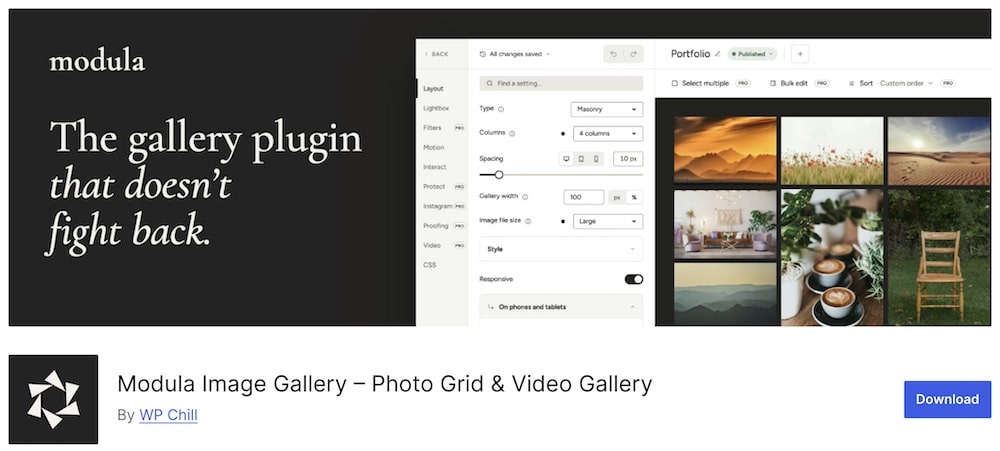
Modula is the one I’d reach for when a plain grid looks a little too… plain.
Its strength is layout control.
The free version gives you seven gallery styles, including masonry, justified, uniform, fit grid, Polaroid, creative layouts, and a custom grid where you can resize and reposition individual images yourself.
That custom-grid approach is what makes Modula stand out.
You’re not just picking columns and hoping for the best.
You can make specific images larger, build more editorial-looking layouts, add content blocks between photos, tweak spacing, captions, borders, shadows, and preview everything on desktop, tablet, and mobile.
The newer editor is also much nicer than the older Modula workflow.
Changes autosave, undo/redo is built in, settings update live, and you can search for a setting instead of hunting through menus.
There’s even optional AI assistance now for things like alt text, captions, CSS, and gallery changes.
Interesting, but I see that as a bonus rather than the reason to install it.
- Best for: Photographers, designers, artists, and anyone who wants galleries with more personality
- Free version includes: Seven layouts, custom grid editing, masonry, justified grids, Polaroid layouts, hover effects, entrance animations, lightbox, social sharing, responsive previews, lazy loading, schema markup, and Gutenberg support
- Pro adds: Video galleries, sliders, albums, filters, pagination, advanced lightbox controls, watermarks, password protection, proofing, image comments, Instagram galleries, and more layouts
- Why we like it: It gives you more creative control over the actual gallery composition than most free plugins
- What I’d improve: Some very useful features, especially filters, albums, video, and advanced lightbox controls, still require Pro
5. Gallery by Visual Portfolio

Visual Portfolio is the plugin I’d choose when your gallery needs to do more than just show images.
It’s built around portfolio and gallery blocks, which means you can create masonry layouts, justified grids, tiles, sliders, carousels, post grids, and filterable project showcases from the same workflow.
That makes it especially useful for designers, photographers, agencies, illustrators, and anyone who wants to present actual projects rather than a random wall of photos.
One of its strongest features is the optional Portfolio post type.
You can keep projects separate from regular blog posts, organize them with taxonomies, and then pull those projects into different gallery layouts wherever you need them.
Performance also gets proper attention.
Visual Portfolio loads scripts and styles only when they’re needed, uses lazy loading, supports adaptive image sizes, and works with third-party WebP and image-optimization tools.
There’s a lot here, but it still stays surprisingly visual.
- Best for: Designers, photographers, agencies, creatives, and project-based portfolios
- Free version includes: Masonry, justified, tiles, grid, slider and carousel layouts, portfolio post types, filtering, pagination, lightboxes, lazy loading, and gallery blocks
- Pro adds: Nested albums, dedicated video items, social feeds, proofing, watermarks, password protection, advanced skins, and deeper query controls
- Why we like it: It combines gallery design with actual portfolio organization instead of treating every image as a standalone item
- What I’d improve: There are enough layout and query options that first-time users may need a little time to understand the full setup
6. SimpLy Gallery
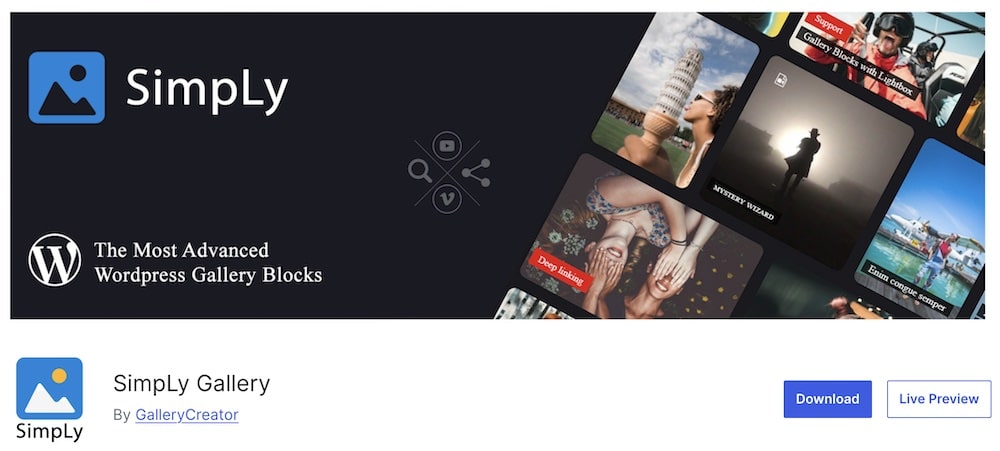
SimpLy Gallery gets interesting when your “gallery” isn’t just a pile of JPGs.
You can mix images, self-hosted video, audio, YouTube, Vimeo, and VideoPress inside the same gallery, then build everything directly in the WordPress block editor.
That makes it a strong fit for event recaps, tutorials, creative portfolios, travel collections, and any site where different media types need to live together.
The free plugin includes eight gallery blocks, covering masonry, justified, grid, slider, viewer, albums, album navigation, and saved galleries.
You can also organize media into virtual folders and tags, reuse galleries across the site, and filter gallery items by tags on the frontend.
I also like how video is handled.
Instead of loading every YouTube or Vimeo player at once, SimpLy Gallery activates only the video currently being viewed.
That keeps video-heavy galleries from becoming unnecessarily bloated.
- Best for: Mixed-media galleries, tutorials, event sites, portfolios, and video-heavy content
- Free version includes: Eight gallery blocks, images, video, audio, albums, lightbox, media folders, tags, filters, and reusable galleries
- Pro adds: Dynamic galleries, more layouts, advanced styling, YouTube/Vimeo source galleries, WooCommerce sources, and deeper filtering options
- Why we like it: It handles mixed media far better than most traditional photo-gallery plugins
- What I’d improve: The interface has a lot going on, so complete beginners may need a little time to learn the media-management workflow
7. Robo Gallery

Robo Gallery is a good fit if you want more than a basic image grid, but don’t want to spend ages configuring it.
You get several layout styles, including grid, masonry, mosaic, justified, Polaroid, and slider galleries, plus a built-in lightbox with fullscreen, slideshow, zoom, download, and sharing options.
Navigation is stronger than I expected too.
You can use pagination, “Load More,” infinite loading, breadcrumbs, search, tag filtering, and even multi-level albums.
It also supports videos alongside images, with sources such as YouTube, Vimeo, Twitch, SoundCloud, Wistia, and others.
For placement, Robo Gallery works with Gutenberg, Elementor, widgets, and shortcodes, so dropping a gallery into an existing site is pretty painless.
- Best for: Blogs, small portfolios, and sites that want flexible galleries without a heavy workflow
- Free version includes: Multiple gallery layouts, lightbox, pagination, albums, video support, hover effects, Gutenberg, Elementor, and shortcodes
- Pro adds: Advanced album structures, search, deeper styling, YouTube channels/playlists, custom hover templates, and more layout controls
- Why we like it: It packs in a surprising amount without making simple galleries difficult to build
- What I’d improve: The settings and interface aren’t as polished as Envira or Modula, so it can look a little dated in places
8. All-in-One Video Gallery

All-in-One Video Gallery is the obvious pick if video is the main event.
Instead of treating videos like an extra media type, it gives them their own proper structure.
You can create video posts, organize them with categories and tags, build searchable galleries, highlight featured videos, and even restrict access by login status or user role.
Source support is excellent too.
It works with self-hosted MP4, WebM, OGV, HLS, and MPEG-DASH, plus YouTube, Vimeo, Dailymotion, Rumble, Facebook, Bunny Stream, and other embeddable providers.
The player can also handle subtitles, chapters, playback speed, picture-in-picture, fullscreen, sharing, and keyboard controls.
For larger libraries, you also get AJAX search and filtering, sorting by popularity or date, pagination, likes/dislikes, comments, bulk CSV imports, Gutenberg blocks, widgets, and a shortcode builder.
In other words, this can grow far beyond a simple video gallery.
- Best for: Video-heavy blogs, courses, communities, businesses, and media libraries
- Free version includes: Video galleries, categories, tags, search, filters, pagination, multiple video sources, subtitles, chapters, blocks, widgets, and access restrictions
- Premium adds: Popup, slider and playlist layouts, automatic YouTube/Vimeo imports, video SEO, thumbnails, branding, front-end submissions, playlists/favorites, and video ads
- Why we like it: It gives video the same organizational depth that serious photo-gallery plugins give images
- What I’d improve: With 100+ settings available, it can be overkill if you only need to embed a handful of videos
Do You Even Need A Gallery Plugin?
Not always.
If you only need to place a few images into a clean grid, WordPress already gives you enough to get the job done.
A dedicated gallery plugin starts making sense when you want more control.
Things like:
- Masonry or justified layouts
- Albums
- Lightboxes
- Filters
- Video support
- Better mobile behavior
- Image protection
- Portfolio layouts
- Client proofing
- WooCommerce integration
That’s where the built-in gallery starts to feel limited.
I’d also use a plugin if galleries are a major part of the site.
Photographers, designers, agencies, artists, event sites, and portfolio-heavy businesses usually benefit from having proper gallery management instead of rebuilding layouts every time.
But for a normal blog with the occasional image gallery?
You may not need another plugin at all.
Less clutter is often better.
Gallery Plugin Vs WordPress Gallery Block
The WordPress Gallery block is simple.
And for basic image grids, that’s actually a good thing.
You can select images from the Media Library, choose the number of columns, adjust spacing, crop thumbnails, and add links without installing anything extra.
For a quick blog gallery, that may be all you need.
A dedicated gallery plugin gives you much more room to grow.
Depending on the plugin, you can add:
- Masonry and justified layouts
- Albums and nested galleries
- Lightboxes
- Filters and search
- Sliders and carousels
- Video galleries
- Hover effects
- Pagination
- Client proofing
- eCommerce features
The trade-off is complexity.
More features mean more settings, more code, and another plugin to maintain.
So I’d keep it simple.
Use the WordPress Gallery block for occasional image groups.
Use a gallery plugin when galleries are an important part of how the site presents content.
And if a lightbox is all you’re missing, you may not need a full gallery plugin at all — one of these WordPress lightbox plugins could be enough.
Can Gallery Plugins Handle Video Too?
Yes, and quite a few do it really well now.
Some gallery plugins let you mix photos and videos in the same layout, while others are built almost entirely around video.
You may be able to add:
- YouTube videos
- Vimeo videos
- Self-hosted MP4 files
- HLS streams
- Video thumbnails
- Playlists
- Video lightboxes
- Categories and filters
Plugins like SimpLy Gallery are great if you want mixed media.
If video is the main focus, All-in-One Video Gallery makes more sense because it gives you proper video organization, search, filtering, categories, tags, and playback controls.
Just keep performance in mind.
Embedding ten video players on one page can get heavy fast.
How To Keep Large Galleries Fast
A beautiful gallery is useless if nobody waits for it to load.
Large image libraries can get heavy quickly, especially when you use full-resolution photos, animations, sliders, or dozens of images on one page.
A few things help a lot:
- Resize images before uploading: Don’t serve 5,000px photos in a 1,200px gallery.
- Compress your images: Smaller files load faster without needing to look bad.
- Use WebP or AVIF: Modern formats can cut file sizes dramatically.
- Enable lazy loading: Images further down the page shouldn’t load until visitors get near them.
- Use pagination or Load More: Avoid dropping 100 images onto the page at once.
- Generate proper thumbnails: Galleries shouldn’t load full-size originals for tiny grid previews.
- Be careful with video: Embedded players and autoplay can add a lot of weight.
- Use caching: It helps reduce the work WordPress has to repeat on every visit. (A solid WordPress caching plugin can handle much of this automatically.)
- Consider a CDN: Especially useful if you have a large audience spread across different countries.
Can You Sell Photos From A WordPress Gallery?
Yes.
But you need the right gallery plugin for it.
Some free gallery plugins are mainly for display, while premium versions can turn galleries into actual selling tools.
That can include:
- Digital photo downloads
- Print sales
- WooCommerce integration
- Client proofing
- Private galleries
- Watermarks
- Password protection
- Image licensing
NextGEN Gallery is a strong option if selling photography is part of the plan.
Its premium tools support eCommerce, proofing, digital downloads, and even print fulfillment.
FooGallery can also work well if you want to connect galleries with WooCommerce.
Conclusion: Which WordPress Gallery Plugin Should You Choose?
For most image-heavy sites, I’d start with NextGEN Gallery.
It gives you the strongest mix of gallery management, albums, lightboxes, organization, and room to grow.
If you want something lighter and easier to work with, FooGallery is a great alternative.
Prefer simplicity above everything else?
Go with Envira Gallery.
For more creative layouts, Modula is the one I’d choose.
If you’re building a proper portfolio, Visual Portfolio makes much more sense than a basic photo grid.
Need to combine images, video, and audio?
SimpLy Gallery is the strongest mixed-media pick.
For a lightweight gallery builder, Robo Gallery does the job without adding too much complexity.
And if your site is mostly video, skip the photo-first tools and go straight to All-in-One Video Gallery.
There isn’t one perfect gallery plugin for every site.
The best choice comes down to what you actually need to display.
Once that part is clear, the shortlist gets much smaller.
Frequently Asked Questions About WP Gallery Plugins
What is a WordPress gallery plugin?
A WordPress gallery plugin is a simple tool for creating custom galleries for your website. While you can use WordPress’ default gallery function, unfortunately, it doesn’t provide enough configurations to create a beautiful one. Thus we suggest using a plugin.
What is the best free photo gallery plugin for WordPress?
NextGEN is the best free photo gallery plugin for WordPress after testing it on 20+ live websites. It offers endless possibilities, making it easily compete with the premium ones.
How to add a gallery shortcode in WordPress?
Adding a gallery shortcode in WordPress is a simple copy and paste process. You can add it to posts, pages, sidebars, and footers; wherever you want a gallery to appear.
Does WordPress have a built-in gallery function?
Yes, it has, but with very limited functionality, so we recommend installing a plugin to enjoy the freedom of designing a media gallery like you want.
What features should I look for in a WordPress gallery plugin?
Look for features like responsive design, easy-to-use interfaces, customization options, social media integration, and support for different media types (images, videos). The plugin should also be regularly updated and compatible with your version of WordPress.
Can gallery plugins handle large numbers of images without slowing down site?
Yes, many WordPress gallery plugins are optimized for performance. They use techniques like lazy loading and optimized image sizes to handle large galleries without significantly impacting site speed.
Are WordPress gallery plugins SEO-friendly?
Most WordPress gallery plugins are designed with SEO in mind. They often allow for alt tags, captions, and titles for images, which can help with image SEO.
Is It possible to create password-protected galleries?
Yes, some WordPress gallery plugins offer the ability to create password-protected galleries. This is useful for sharing private galleries with a select audience or clients.
Do gallery plugins support video content?
Many gallery plugins do support video content, allowing you to create mixed galleries with both images and videos. Some plugins even support embedding videos from platforms like YouTube and Vimeo.
Can I add social sharing buttons to my gallery?
Yes, many plugins, like “Envira Gallery” and “NextGEN Gallery,” offer social sharing options so users can easily share your images on platforms like Facebook, Twitter, or Pinterest.
What’s the difference between a gallery plugin and WordPress’s built-in gallery?
A plugin offers more layouts, effects, and customization, while WordPress’s built-in gallery is basic and lacks advanced styling options.
::
Note: This article was originally published on August 24, 2021. But our team regularly reviews it and updates it with necessary improvements for accuracy.